Ten dollar click

clicksia

Bidvertiser

Miami Beach Film Society

Start your own business plan »

Art Film Theater Business Plan


Executive Summary

The Miami Beach Film Society (MBFS) is a not-for-profit 501(c)(3) organization that is expanding to finally have a permanent home, The Miami Beach Cinematheque, which will not only serve as the home but will also be the office/headquarters for MBFS' main annual event, THE FESTIVAL OF FILM FESTIVALS: The Miami Beach International Film Festival (MBIFF), which will debut in the second year of Cinematheque operation. This plan concentrates on the first year of operation, opening the Cinematheque with a strategic start-up "Founding Circle", and then operating it through creative programming, marketing, product and service sales, and fundraising.
We are seeking funding to add to our previous donations, for initial start-up expenses to be used for build-out, rent and related issues, equipment, and initial cash to handle the first few months of expenses. Our annual revenue will continue with a combination of memberships, admissions to programs, product and services sales, fundraising activities, and city, county, and state grants.
We have already formed several strategic alliances with various organizations and businesses that will help or have helped to make the Cinematheque and MBIFF a success. During the first year of the Cinematheque, our business goals are in five main categories:
  1. Opening the space successfully;
  2. Generating earned revenue from a combination of ticket sales, product and service sales, and additional fundraising;
  3. Keeping gross profit margins high; 
  4. Raising substantial percentages of revenue from grant sources to develop and maintain membership level;
  5. Including outreach as a main goal to include various audiences.
The Miami Beach Film Society's mission is to provide a cultural alternative to the commercial film experience, and to celebrate and promote the artistic elements of the medium and related ones, and to nurture and promote the art of filmmaking itself. Included in the mission will be special consideration for the cultural diversity of Miami Beach. The Cinematheque will be a base to utilize, enjoy, learn, and discover. It will also be a workplace of inclusion and respect, with a focus on the development of creativity and ideas.
MBFS has been programming special events for years, and the MBFS specialty has been success with collaboration with other cultural institutions, its creative programming utilizing the uniqueness of Miami Beach, and its outstanding sense of marketing.
The products and services provided by the Cinematheque will all complement the main mission of the organization, to provide a cultural alternative to the commercial film going experience. The standards of quality of the merchandise and services presented will be based on creativity and imagination, culminating in a unique experience for cinematheques. The Miami Beach Cinematheque will be different. Such creative programming as  "Food & Film: Movies To Dine For", "Yoga & Film", and "Cafe Con Cinema" combines the intriguing and sometimes provocative aspects of our diversified local culture, supplemented by high quality merchandise that serves as educational souvenirs and reference material.
Our core market for the Cinematheque is the type of person who appreciates the arts and cinema in particular, and is interested in an alternative to the typical commercial offerings in the film and arts experiences. This core market exists in all the categories of our main markets, as described in detail in the Market Segmentation section, and our target markets are based on the biggest percentages of the pie, but we would like to develop the smaller percentages of the pie also, so we are targeting certain markets to develop that support.
There is no organization in South Beach that currently provides the services and emphasis that MBFS will provide for Miami Beach. Recently The Alliance "arthouse" Cinema on Lincoln Road closed, so the Cinematheque is filling an important gap in alternative programming. Our hard core film audience will be pleased to know that programming will be aimed in their direction, but with a different package. Squeezing seven nights out of an audience that supports one or two on a regular basis is why we will have programming such as "Views From the Underground" and "Foreign Film Fridays" in our programming line-up for niche markets and outreach for underserved audiences, as well as "Jazz or Classical Filmbrunch" featuring live entertainment and a lighter fare appealing to a wider audience.
With our singular focus on film and related arts, we have a solid direction and we are positioned as the premiere source for cinema and photographic arts presentation and education in Miami Beach. The Cinematheque will be the main venue for film appreciation, enrichment, and enjoyment of all the related arts and activities tied to the art of film. Therefore a marketing focus will be on these benefits of visiting and participating in the Cinematheque. Through our diverse range of programs, a fresh experience for frequent visitors will provide an ongoing development in the appreciation, enjoyment, and education that the Cinematheque offers.
Key areas of our marketing strategy include membership development, development of the Founding Circle, The Cinematheque Newsletter and other direct mailings, telemarketing, on-site marketing of Cinematheque products and services, targeted advertisements, general listings,  the website, radio and Public Service Announcements (PSA), flyers, programs, and brochures, the database, and  press contacts.
MBFS has begun an extensive fundraising campaign to provide initial start-up costs for the Cinematheque. Each area of need will be strategically matched with a potential donor, starting with construction costs and ending with festival grants. The areas of fundraising include the Start-Up Donor Drive, grant development, fundraising events, hiring fundraising professionals, and sponsorship agreements, as well as research of other film festival operations.
The Miami Beach Cinematheque website www.mbcinema.com will be an example of the creativity and style for the film society and the eventual film festival. The website will have strategic directional links on all pages to lead to sales, whether on-line or later on-site. The Miami Beach International Film Festival website will be separate, www.miamibeachfilmfestival.com, and the two sites will mutually benefit by being linked at many strategic points.
Run for years by a Director and Board of Directors, the opening of the Cinematheque will expand the team to include an Operations Manager, and the Director will assume that position as he always has until the need arises to make it a paid position. As always, there will be volunteers in several capacities, and the volunteer Board will play a big part in organizing this area. They each will have a role in managing an area of volunteer duties. As the time comes closer to the Miami Beach International Film Festival (MBIFF) development, the team will be in place, ready for the bigger project, with potential managers in line for paid positions as they are needed. The Board of Trustees (Trustees), also volunteer, will be expanded and developed by the Director and Board to make available expert advise, donations of in-kind and products and services.
Founder and Director Dana Keith, Director of the Miami Beach Film Society since 1993 when he founded the non-profit organization, is uniquely qualified to run this project, which he has developed since incorporation. He has two bachelor's degrees, one in Cinema (emphasizing film history, aesthetics, and criticism), and one in Fine Arts (emphasizing graphic arts with  photography/photolithography), from the University of California, Santa Barbara. His film exhibition background includes management of the Arlington Center for the Performing Arts in Santa Barbara, and The Red Rock 11 Theatres, at the time the world's largest theatre complex. Researching for Cinematheques and Museums for ten years in Europe has influenced his interests and has been invaluable in developing the conceptual ideas of the film society and Cinematheque. His collection of souvenir programs from all over the world covering the entire history of cinema is considered by experts as one of the world's best, and will be a large aspect of the Cinematheque for marketing, exhibition, and education.
The Board of Directors has remained intact for years, serving in many capacities and helping to make MBFS a major part of the cultural structure of Miami Beach. Actress Barbara Pergament - Chairman, Lucille Acocella of Northwest Airlines - Secretary/Treasurer, George Neary, the Director of Cultural Tourism for The Greater Miami Visitors and Convention Bureau, Marybeth Sheehan with DeNiro Realty, Cristiane Roget of AP+Films International, and Seth Finkel, Esq. - Legal Consultant have all been long time volunteer supporters, and will now be even more instrumental in the expansion of the Society, helping to develop the Board of Trustees, and helping to guide the organization.
In line for important positions on the team include future Programmers/Production Directors Juan Carlos Zaldivar and Rhonda Mitrani. Director/producer Juan Carlos Zaldivar completed both his BFA and MFA in film studies at NYU Film School, served as a juror for the Sundance Film Festival short film category, and wrote/directed the Sundance trailers that year, How To Make A Bird, How To Make A Tree, and How To Make A River. He was elected a Sundance Film Institute Fellow that summer. Juan produces for the PBS show In The Life. He teaches at the Undergraduate Film Program at NYU, and is a member of the National Association of Latino Independent Producers.  
Rhonda L. Mitrani, Director/producer/editor, is graduate of the University of Michigan, BFA. She began her film career at Miramax Films in New York as Post Coordinator on such films as Marvin's Room, and assisted on Modulations which played at Sundance and Berlin Film Festivals. As editor, she was principal on such films as Hit and Run, and edited for the Internet company Pseudo Programs and recently for the film The Suitor. She is a regular editor for ABC news. Cuba Mia is her first feature documentary.
Other team members include Technical Coordinator Aleksandar Stojanovic of CWS Productions, Grants Consultant Pola Reydburd, Special Events Producer Paulo Sadri with TMG Productions, International Film Festival Liaison Sandy Mandelberger of International Media Resources,  and North and South American Correspondent Jesse Rodriguiz based in Chicago. This international team forms the basis that will help make the Cinematheque and MBIFF a major success. The team is expected to grow as we develop.
The balance sheet and the various tables of this plan show managed but sufficient growth of net worth, and a sufficiently healthy financial position. The yearly and monthly estimates are included in several topic areas, and in the appendix.
With continued growth as allowed by this strong plan, MBFS will be in position to continue development for the Miami Beach International Film Festival, which will grow after the first year into a major international film festival, while the Cinematheque continues to thrive as a successful addition to Miami Beach culture.

1.1 Objectives

During the first year of the Cinematheque, our business goals are:
  1. To open the space on Espanola Way with a basic build-out, helped by the in-kind and monetary donations of appropriate partners, individuals and businesses. 
  2. To generate over $10,000 monthly in earned income by the end of the first year from a combination of ticket sales to various programming, memberships, retail sales in several departments, outreach, meeting space fees and related services, Internet and telephone services, and additional fundraising.
  3. To keep a strong gross profit margin of at least 60% from sales of products and services. 
  4. To receive at least $10,000 in the first year from newly developed funding sources such as grants that will come over time depending on deadlines and qualifications.
  5. To develop and maintain a strong membership base at different levels of donorship.
  6. To develop an outreach program that includes new markets and opens the doors for the ultimate programming goal: The Miami Beach International Film Festival, which will debut just months into the second year.

1.2 Mission

The Miami Beach Film Society's mission is to provide a cultural alternative to the commercial film experience, and to celebrate and promote the artistic elements of the medium, and to nurture and promote the art of filmmaking itself. The Cinematheque will be the home of MBFS, and will provide an historical and unique environment for the the Society to pursue its mission.
Included in the mission will be special consideration for the cultural diversity of Miami Beach and the world, and the Cinematheque will serve as a base for the promotion of the inclusion of international elements, with the ultimate display being The Miami Beach International Film Festival. The Cinematheque will become the base for film and arts appreciation for a wide spectrum of local cultural communities and visitors alike. It will a place to utilize, enjoy, learn, and discover. It will also be a workplace of inclusion and respect, with a main focus on the development of creativity and ideas.

Film Funding Fundamentals - Writing a Solid Film Business Plan


Wondering how to get your film funded? Wondering what's in a film package that gets funding? This article is for you. Practical, pragmatic, easy to follow advice you can use to write a business plan that will help get your film produced.
  • Film Funding: The Cold Hard Facts

    Article ImageOnce you've launched a film production company, the next step is looking for funding for your productions. Funding a film is much easier than you may have heard. Most of the people writing books and teaching classes how to raise money for a film have never actually managed to do it themselves. This makes them set the bar to unachievable things like A-List Cast or Signed Distribution Agreement. Some of the things you may have been told you need may actually be liabilities in the eyes of most funders. Expensive cast and bad distribution deals make a film very hard to fund.
    The truth is, films get funded because they have a good "package" in most cases. A film package is nothing more than a very solid and attractive business plan for funding, a good script, reasonably priced/well-known talent, proven key crew, the right budget, asolid marketing strategy, the right distribution plan and rational financial projections.
    The right film package in the hands of the right funder always results in investment.
    Image courtesy of Andrew Magill (cc)
  • How to Write a Film Business Plan

    Film packages are created by film producers. Sometimes the producer of a film is also its writer, or its director, or its leading man. A film producer is just the guy who decides he is going to take responsibility for putting all the pieces of a film together, from the caterer to the camera man, from the leading man to the editor. The producer embodies and champions a film before it is made.
    To create a good film package, a producer must simply decide that they alone are responsible for creating a profitable film.
    Most unsuccessful film producers have a distribution plan that stops with "get a distribution deal" or "get a sales agent". Their marketing plan stops with "get our film into festivals."
    See the complete Bright Hub Guide to Running an Online Business »
    A good producer explicitly and concretely nails down exactly how a film funder is going to get their money back. Producers prove, through their package, that they have created the relationships, skills and information required to make a film make money.
  • Read on to the next page to find out more about what should be included in the business plan for a fundable film package.
  • Atlhough many of the components of a film business plan are similar to those found in any business plan, there are definitely a few extra items that you need to include. In this guide on how to get your film funded, Nancy Fulton takes a look at what should be included in a film business plan to increase your chances of getting funded.
  • What's in a Fundable Film Package

    Film packages vary from film to film and from producer to producer. Proving you can produce GONE WITH THE WIND and sell its rights profitably takes a more complex plan than a plan to produce and distribute CUBE profitably. One is three hours long, has hundreds of scenes, thousands of cast members, and it is about the unpopular topic of slavery. CUBE requires one set, a few actors, and a lot of moving around.
    The following elements may appear in a film package:
    A script which has been carefully chosen and tested. Tested means that it has gone through multiple readings with multiple actors, directors, line producers, and others. A script has to be something actors want to be in, that directors think is worth producing, that line producers think is cost effective and safe to make. A script that gets through that process is one that most investors will like.
    A shooting schedule which has been produced by a line producer with lots of credits. You might as well make the line producer the piece of the puzzle you get after the script. Pay him to break down the script, to create the shooting schedule and the defacto production budget. The shooting schedule lists the locations, scenes and actors you need to make the film. From the shooting schedule the line producer can create the budget. Don't try to do this yourself unless you are very familiar with labor laws, union rates, and have line produced a few dozen productions yourself.
    A production budget that completely describes the costs of production. It should also cover the costs of editing, post production, writing, directing, producing and executive producing the project. In mine I also like to include cost associated with prints, advertising and theatrical release. The budget you give a funder should include all the costs of funding the film. The more exhaustive and accurate your cost analysis is, the better your chance of funding. Do not try to copy someone else's budget and tailor it for yours. That doesn't work and it can get you into a lot of trouble because it will look like a reasonable budget but it won't be.
    A marketing plan that accurately describes who the film is for and how you will know for a fact that those people will like it. The marketing plan should discuss similar films, methods of reaching your target markets, who you'll be working with to implement marketing, how much marketing will cost, and how it will be staged over the production and release of a film.
  • On the next page, we'll cover additional components that should be included in a fundable film package.
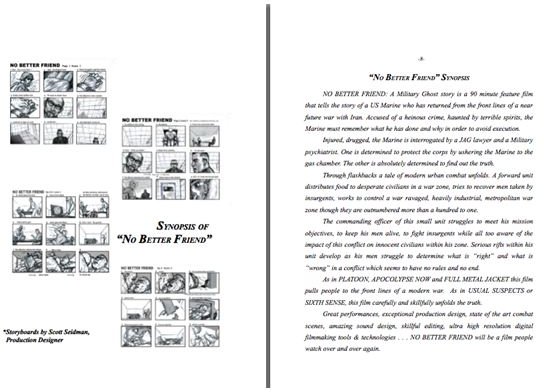
  • Business Plan Story Board by Scott Siedman

    Business Plan Story Board
  • Once you've put together a film business plan, then what? Nancy Fulton gives tips on where to send your film proposal as well as some valuable advice on scams to avoid.
  • What's in a Funding Film Package (continued)

    A distribution plan that describes exactly how a film will be distributed. How can you absolutely guarantee theatrical release? How can you ensure the sale of PPV and cable rights, overseas rights, broadcast rights, DVD rights, and any subsidiary sales? Nothing must be left to chance in the distribution plan. You do not need to have a distributor signed onto your project in advance of production, and in fact this can be a liability. The deal most producers can cut with a distributor before production are very bad. Distributors value a finished commercial film and a good P&A budget.
    Biographies and letters of interest from the right crew. A good line producer is absolutely essential. The line producer is what gets you a good completion bond and good insurance rates. A good Director of Photography will have good credits and great portfolio. Art director, production designer, 1st Assistant Director and obviously a Director with good credits if possible. Since many writers these days are also directing, funders may accept a good line producer and 1st AD with DGA credits as back up for a new Writer/Director. The object is to prove that your team can produce commercial quality films.
    Pictures of key cast, with letters of interest if available. You can call agents for most actors to ask for their availability and budget rates. Most will not read a script or provide a letter of interest unless you have an employment contract and funding in place. Funders understand that talent can be determined after funding is in place. They just need to know who you are looking at and how much you plan to pay them. They will want to have the right to approve key cast, just to ensure you don't cast someone who they find completely unacceptable.
    Revenue projections backed up with lots of analysis. You should show how 15-20 very recent films very similar to yours have performed in theatrical release and DVD sales. You can find this data on www.boxofficemojo.com and www.the-numbers.com. You should project the value of rights sales based on industry averages by regions. You may find www.filmspecific.com has resources that will help you meet this requirement. You should include revenue from product integration (www.brand-inentertainment) and state film production rebates as well.
    A letter of intent for a completion bond from a reputable bond company. You can get this if you have all the other pieces in place and you know where you'll be shooting. You submit the package and they decide how much the bond will cost. Often you will have to pay your line producer to work with them. A good line producer will have bond companies he works with often
    A letter of intent to insure your film from an insurance company. Your line producer should have a good insurance contact as well.
    By the time you have all that compiled, you have a very solid film package. Adding some storyboarded scenes, a commercial quality poster, a photographs of locations and some clipart (available from clipart.com) complete's the package. Turn the document, or documents, you've assembled into one or more PDF files you can email to funders. This is easy to do using default tools on a Macintosh. On a PC you may have to purchase BCL PDF which will let you "print to a PDF file". No funder I've ever met prefers paper documents.
  • Where Do You Send The Package

    Film funds make a business of funding films, so they are a good place to start. You can find them on Google. You can also find private lenders that specialize in funding films, and private investors who are willing to consider film packages. There are literally thousands of funding sources available once you begin to look for them.
    You should never pay up front for help getting your film funded. You should look very carefully to ensure that anyone you work with has funded other films. Before signing an agreement with anyone to fund your film, make sure they can provide "proof of funds" and ensure that those funds they provide proof of are the ones that will be used to fund your film. Make sure the funds are domestic, and that your funding contract has specific dates for when you will receive funds. Failure to receive funds by that date should allow you to terminate the contract without losing anything. Do not start production until all the funds you asked for in your package are escrowed. You may want to run credit and background checks as well.
    Now that you've reviewed this rather long document, you should be ready to put together a film package that can actually get your film the investment that it needs.

THE FILM BUSINESS: HOW TO PRODUCE FEATURE FILMS

Film production, like any business, is a trade that can be learned. This series of articles its a nuts and bolts introduction to the business of film for new and struggling film producers. Learn how to find film funding, how to create a film package investors like, how to choose a script, and more.
  1. Film Funding Fundamentals - Writing a Solid Film Business Plan
  2. Marketing an Independent Film or Documentary through Press Releases

Starting Up a Film Production Company


Do you know how to make a movie? Becoming a film producer is not only an opportunity to capture the hearts and minds of millions of people, it is also an opportunity to build a strong, relatively easy to fund, robust business that can deliver millions in profits over the course of a few years.
  • Film Production Companies Make Profitable Small Businesses

    As a startup business, film production companies have to be considered one of the best. For example, did you know that film is a nationally subsidized business in the United States? Many states offer large cash rebates that return a percentage of the money spent in the state to the production companies who film there. Michigan currently offers a 40-42% tax rebate, New Mexico offers 25%, and Georgia offers a 30% rebate. Film is an attractive industry to have in a state because it provides high paying jobs, lots of tax revenues, produces little in the way of toxic waste, and its the kind of industry that can grow and prosper very quickly in the right environment.
  • Article Image
    Another nice thing about film is that it provides many possible revenue streams. Before production, a production company may be able to receive payment for integrating products into a film. After production it may be able to receive ticket revenues from theatrical releases, revenues from PPV and cable rights sales, overseas rights sales, broadcast television rights sales and DVD rights sales. These are just a few of the revenue streams a good, high quality film, can exploit.

    Finally, films are very fast turnaround businesses. Unilke an Internet startup which might take five years to turn a profit, or a manufacturing company which might take a decade, film production companies can develop a project, produce it, get it into theatrical release, and sell off its rights in a matter of three years. In some cases, films generate revenues for decades.
    The intrepid souls that launch small businesses usually follow their heart in the businesses they choose. That's actually an important thing to do. Every small business requires endless twelve hour days and lots of hard work to launch. If you have a passion for film, a very solid understanding of small business management skills, the ability to identify commercially viable projects, and an absolute determination to produce the best films anyone has ever seen, starting a film production company may be the right decision for you. Taking this route is definitely a very viable career option for someone with a communications degree.
    See the complete Bright Hub Guide to Starting a Business »
  • Is a Film Production Company Really a Small Business?

    Feature films and television shows rarely show you the truth about film production companies. That is because film production companies don't look all that exciting until the cameras start to roll. The truth is, most film production companies are composed of two to five people who work to put one or more films together. They may or may not have an office for most of the time they are working. They may not even have a dental plan. What they do have is a film they want to make and a blueprint for how it will be done.
    A film production company is absolutely a small business all the way up until it is funded and it has moved into production. Then, for a period of weeks, it is a big business. It often has more than 100 employees, union contracts, large insurance policies, millions of dollars in its bank accounts and lots of people looking over its shoulder.
    After that, the production company goes back to being small again. The footage shot by the production company is edited, music is added, special effects are put in, and the whole package is sold a few rights at a time to folks around the world.
  • What Does It Take to Launch a Film Production Company?

    The first step in launching a film production company is to start an LLC or Corporation. In most cases you will start an LLC because it protects your personal assets against being taken away if your production company is sued. Starting an LLC takes about two hours, requires two forms, and may obligate you to paytaxes in your state even in years you don't make money. It is something you may want to talk to a lawyer about.
  • A Good Film Package Yields Lots of Investment
    The next step is finding, or writing, a great script that you want to produce and then building a business plan around it. There is a very clear and straight-forward path to creating a fundable feature film business plan. It requires hiring a line producer, getting a shooting schedule and budgets done, identifying key cast and crew, creating financial projections, developing a marketing plan, and creating a distribution plan.
    Once the business plan is developed, you present it to business professionals as you would any other revenue opportunity. There are several ways to structure the money you get to make a film. Some film productions are funded through loans. Some are funded through active investors. Some go to the expense of setting up a Private Placement which allows them to sell shares to investors. How you decide to structure funding has everything to do with the size of the film you want to make and the funders you are working with.
    Once you have funding you produce the film as specified in the plan and start realizing the revenue streams it specifies.
    Having produced one film, most production companies roll on to producing others. It is something that people get better at with practice.
  • Is It Really Feasible to Launch a Film Production Company?

    Every start up business is good for one kind of person and not another. The guys that launch Google in their dorm room are not the folks that launch Estee Lauder in their kitchen.
    Film production, as a business, requires that you be hard working, intelligent, practical, pragmatic, insightful and creative. You need exceptional verbal communication skills, great writing skills, a clean business history, and the ability to work in a fast changing business environment. It helps to have industry contacts so you can quickly find good line producers, key crew and great talent but these are things you can also acquire over time. It is very nice to start with $50K-$100K to develop your first project, but people have managed with less.
    It is definitely possible to launch a successful film production company. For the right people it is the best business on earth.

Business Model and Marketing Plan Components of a Business Plan


Having understood the main components of a business plan in Part 1, the next questions to be addressed are what product-service mix will the venture get into and how will the business generate revenues and profits? Answers to these questions can be found in the business model and the marketing plan.
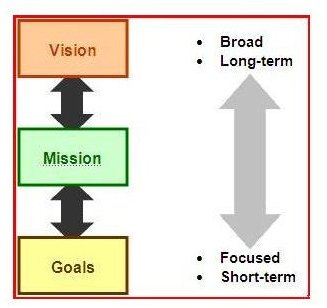
  • Vision, Mission, Goals, and Business Model

    We again go back to our intuitive process for understanding the jargon used while developing small business marketing ideas and translating them into a formal business model. Once an entrepreneur has decided to start a business, (s)he already has a mental picture of what (s)he wants to achieve from a long-term perspective.The mental picture also defines in broad terms how the business will operate and how it will benefit the entrepreneur, the society, the government, and other stakeholders. This broad mental picture is what is stated as the Vision of a business, and the purpose behind this Vision is what is called theMission Statement of the business.
  • Vision, Mission, and Goals of a Business PlanThe Business Model, in a macro sense, is the framework you intend to use in order to create value to the stakeholders in line with your Vision and Mission. And in micro terms, the Business Model constitutes how your business will generate revenue, what products and services you plan to provide to your intended market, how will these products and services reach your clients, and how will you source your inputs - the entire supply chain. It is at this stage that you need to spell out the specific Goals your business will achieve.
    Thus, the very first component of your Business Plan will spell out your Mission and Vision, the short-term Goals, and the Business Model you propose to achieve your Goals. For example, the Business Models used by a manufacturer and a distributor or retailer are different from each other. The Business Models used by Microsoft and by Red Hat are entirely different, in delivering operating systems (Windows and Linux) to computer users. Think about the differences, and the concept of a Business Model will be very clear.
  • Writing out the Marketing Plan

    Intuitively, it must be clear to you that the Business Model developed by you needs to be driven by a plan for taking your product-service mix to the market. This plan is what we call the Small Business Marketing Plan. So, how do you crystallize this plan and put it down in writing?
    See the complete Bright Hub Guide to Marketing Your Business »
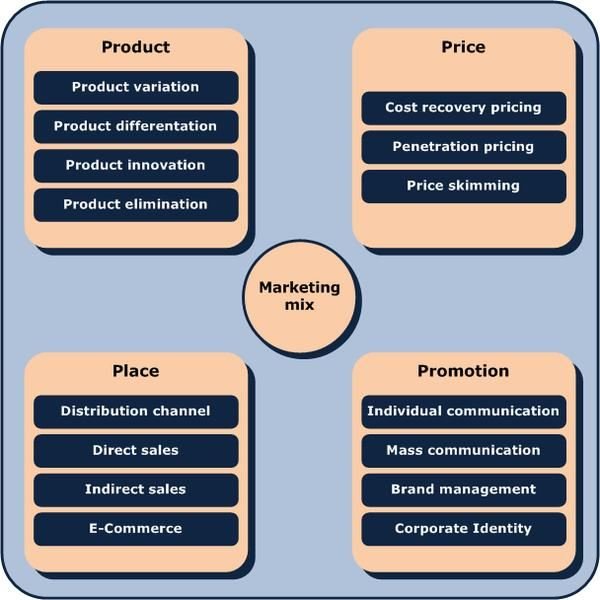
    Let us start with the basic components of a marketing mix. If you know about Philip Kotler's 4 Ps of Marketing, well and good, but if you don't there is no reason to panic. It is basically what you would have thought about intuitively. The small business marketing ideas will lead you the defining these 4 Ps:
    Marketing Mix - 4 P's of Marketing
    Product Plan - What products and/or services are you planning to market? How much (quantity) will you sell during the next three years?
    Pricing Plan - How will you price your product / service? Will you price it at a premium to the competition, or will you skim the market
    Place Plan - Where will you be selling your products and services? What channels of distribution will you use? How much will that cost? What are the benefits?
    Promotion Plan - How will you promote your product/service in order to sustain the product and pricing plans? What mix of advertising media, marketing collaterals, promotional events? And how much will these cost?
    Answers to all these questions will give you the first step in your small business marketing ideas - what is traditionally referred to as the marketing strategy, again something you have already thought about in your mind, right? Once your base ideas are clear, you are ready to now determine what kind of a marketing organization you need to achieve your small business marketing ideas. This is what leads to your small business marketing plan. It will be a good idea to back up your answers with some market research and follow an appropriate template for putting down the figures while computing the marketing organization and the resources you need to achieve the plan. For cases like these, a software application like Business Plan Pro can be a big help.
  • The Small Business Marketing Plan Format

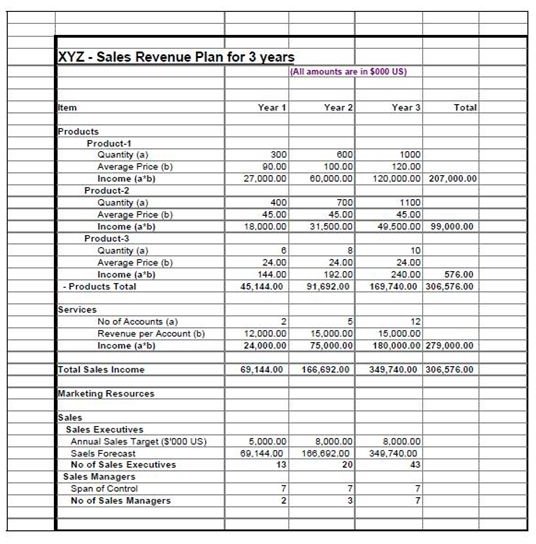
    For putting the figures down to calculate the resource requirement against the sales revenues you have projected, we will use a simple intuitive format. As you will notice in the sample Small Business Marketing Plan Format, you prepare a table with rows and columns (this sample has been prepared in MS-Excel). We prepare the projections for three years: Year 1, Year 2, and Sample Small Business Marketing Plan FormatYear 3. First task is to forecast the sales quantities you expect to achieve for each product in the three years. Then put down the expected average price. With this you get the forecast sales revenue from Product-1.
    Repeat this step for all product and services, and you get the total sales income for three years. Now to derive the sales force required, you first need to decide on a target you would like to set for your sales executives for each year. Since you know the forecast sales figures, you can derive the number of sales executives for each year (by dividing the sales income by the target per sales executive). Thus you get the number of sales executives (13, 20 and 43 in Year 1,2 and 3 in the sample Small Business Marketing Plan Format).
    Next you need to estimate the number of sales managers to supervise and manage these sales executives. Generally, you assume that 1 manager is needed to control 7 executives (also referred to as span of control). Thus we have the number of sales managers in the last row of the sample plan.
    Thus you are now ready with the Small Business Marketing Plan Format for Sales Revenues and the resources required for sales. Adding the support staff for marketing, and the marketing expenses for promotion, and other overheads like travel will give you the total picture of gross income and the selling expenses.
  • Conclusion

    In summary, therefore, we have now seen how intuitively you can write out the Vision, Mission and Goals for your business, and using the goals set by yourself for three years, how the small business marketing ideas evolve in the form of the product-service mix. Using the marketing mix and the marketing strategy adopted, we have seen how the three year sales forecasts can be drawn up, and from there how the sales resources can be derived, giving you the entire groundwork for your small business marketing plan. In the next two parts of this series, we will visit the other components for writing the business plan.

WRITING A BUSINESS PLAN: STEP BY STEP

This series will walk the reader through the steps involved in writing a detailed business plan. The guides have been written using the natural intuitive thinking approach, so that the entrepreneur realizes the structure behind the written plan, and appreciates its value.
  1. Writing a Business Plan - Simplified
  2. Business Model and Marketing Plan Components of a Business Plan
  3. Manpower and Capital Expenditure Components of a Business Plan
  4. Writing a Business Plan (Part 4): Projected Profit and Loss Statement and Balance Sheet
  5. Writing a Business Plan (Part 5): Cash Flow Projections and Ratio Analysis

Guides and Strategies for Running an Online Business


Running an online business is becoming more popular as employers are seeing that they can save money by hiring 1099 employees and allowing them to work from home. Before starting an online business, you must learn about the requirements of owning a business.

References